


As an ophthalmologist, one of the most common complaints I hear today is, “Doctor, my eyes feel tired all the time.” A decade ago, eye strain was usually associated with people who spent long hours reading or working in specific professions. Today, it affects almost everyone—from school-going children and college students to working professionals and senior citizens.
At our AIMS Hospital in Aundh Pune, we are seeing a growing number of patients with symptoms such as eye strain, dryness, headaches, blurred vision, and difficulty focusing. While many people worry that screens are permanently damaging their eyesight, the reality is a little more complex. The problem is not necessarily the screen itself, but the way we use it.
Modern life revolves around digital devices. We wake up and check our phones, spend hours working on computers, scroll through social media during breaks, and often end the day watching videos before going to sleep. For many individuals, screen exposure has become nearly constant. The eyes were never designed to focus on digital screens for such prolonged periods without rest.
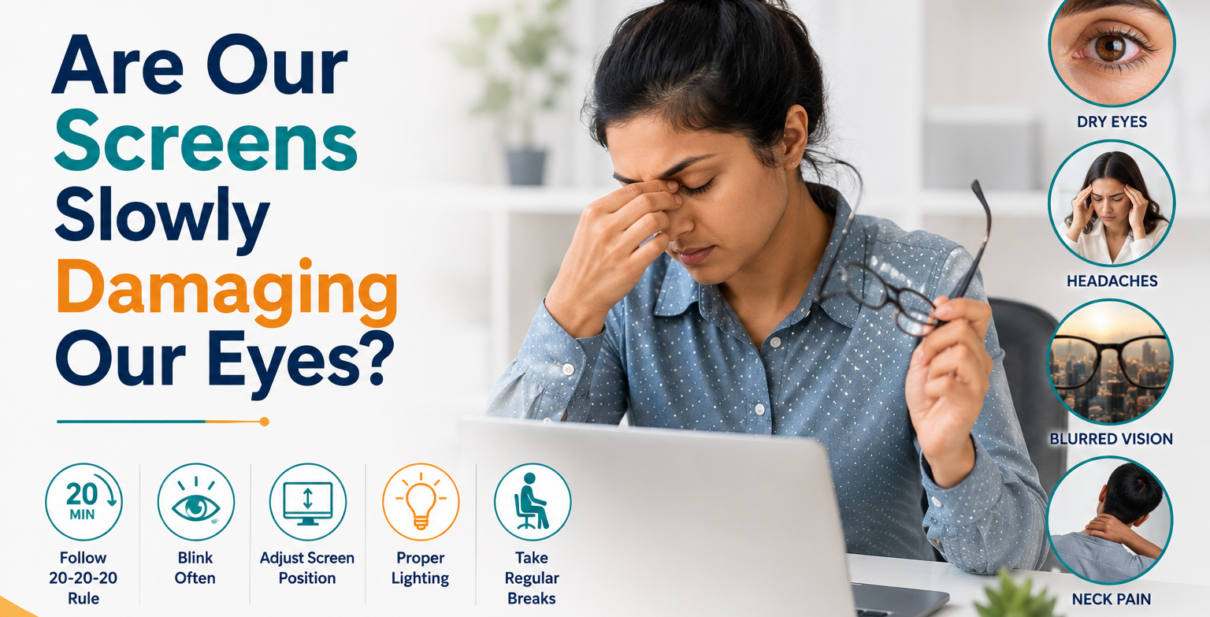
One of the most common conditions we encounter at our AIMS Hospital in Aundh Pune is Digital Eye Strain, sometimes referred to as Computer Vision Syndrome. Patients often complain of tired eyes, burning sensations, watering, blurred vision, neck pain, and headaches after extended screen use. These symptoms are becoming increasingly common because people are spending more hours than ever in front of digital devices.
A major reason for this discomfort is that we blink less frequently when using screens. Under normal circumstances, blinking helps keep the surface of the eye lubricated and comfortable. However, when concentrating on a phone or computer, blink rates can decrease significantly. This leads to dryness and irritation, which many people experience by the end of the day.
Children are another group that concerns ophthalmologists. At our AIMS Hospital in Aundh Pune, we have noticed a steady increase in parents bringing children for vision assessments. Online learning, digital entertainment, and mobile gaming have dramatically increased screen exposure from a young age. While screens alone do not necessarily cause serious eye disease, excessive near work and reduced outdoor activity have been linked to rising rates of myopia, commonly known as nearsightedness.
What worries me more than screen time itself is the habit of ignoring symptoms. Many patients assume that eye strain is simply part of modern life and continue pushing through discomfort. They purchase over-the-counter eye drops, adjust screen brightness, or try temporary solutions without understanding the underlying issue. In some cases, symptoms that appear to be related to screen use may actually indicate an uncorrected vision problem that requires professional evaluation.
Another misconception I frequently encounter is the belief that wearing glasses weakens the eyes. This is simply not true. Glasses help correct refractive errors and reduce strain on the visual system. Patients who avoid wearing prescribed spectacles often end up experiencing more headaches, fatigue, and difficulty concentrating than those who use them appropriately.
At our AIMS Hospital in Aundh Pune, we encourage patients to adopt simple habits that support eye health. The 20-20-20 rule is one of the easiest and most effective strategies. Every 20 minutes, look at something approximately 20 feet away for at least 20 seconds. This gives the eye muscles an opportunity to relax and reduces visual fatigue. Adequate lighting, proper screen positioning, and regular breaks can also make a significant difference.
Sleep is another often-overlooked factor. Many individuals spend hours on screens late into the evening and then wonder why their eyes feel uncomfortable the next day. Poor sleep affects the eyes just as it affects the rest of the body. Dryness, irritation, and visual fatigue often become more noticeable when the body is not adequately rested.
The encouraging news is that most screen-related eye symptoms can be managed effectively through lifestyle adjustments and regular eye examinations. Early detection of vision problems allows for timely intervention and helps prevent unnecessary discomfort. Modern ophthalmology offers excellent diagnostic tools that allow us to assess eye health in great detail.
As an ophthalmologist, I believe screens are not the enemy. They have transformed communication, education, and healthcare in remarkable ways. The challenge lies in learning how to use them responsibly. Just as we pay attention to posture while working or exercise to maintain physical fitness, we must also develop habits that protect our eyes.
At our AIMS Hospital in Aundh Pune, we remind patients that vision is one of their most valuable assets. The eyes work continuously throughout the day, often without appreciation until problems arise. Paying attention to symptoms such as dryness, blurred vision, headaches, or eye strain is not a sign of weakness—it is a sign of good health awareness.
The next time your eyes feel tired after a long day of screen use, don’t simply ignore the discomfort. Your eyes may be asking for something very simple: a break. Listening to them today can help preserve comfortable and healthy vision for years to come.